Set Theory for Beginners
Read what professionals in our community say about Set Theory for Beginners.
Subhomoy's Set Theory for Beginners balances nuance and simplicity, appealing to a novice audience without alienating more experienced readers. The tactful use of illustrations, a strong theoretical foundation, and examples from everyday life serve to communicate complex ideas in a fun, easy way.

Set Theory for Beginners is a masterfully written introduction to one of the most fundamental concepts in mathematics. The author presents complex ideas with clarity and intuition, making the subject accessible to both developers and math enthusiasts. The book not only strengthens the reader’s mathematical foundation, but also provides hands-on experience with programming applications.
This book is very easy to access for beginners, making set theory simple to understand. Even without any prior SQL experience, the tutorials were clear and easy to implement. Subhomoy’s explanations and real-world examples make learning both fun and practical.


Paperback copies of Set Theory for Beginners by Subhomoy Haldar
£9.99 33% off vs Kindle price
ISBN: 978-1-0685741-0-8
Instant delivery. DRM-free. Secure checkout
£16.99
ISBN: 978-1-0685741-1-5
Contact us for details on signed copies.
Covered by Amazon's return policy
Also available through library lending services including OverDrive, cloudLibrary, Baker & Taylor, and BorrowBox.
Read a sample from the book for free:
Level up your Logical Reasoning and Mathematical Understanding through Set Theory Fundamentals!
Dive into “Set Theory for Beginners” by Subhomoy Haldar and discover how mastering the fundamentals of Set Theory can revolutionise your approach to problem-solving in mathematics, computer science, and beyond. This comprehensive guide makes complex concepts accessible and engaging, ensuring you gain both the “why” and the “how” behind the theory.
Why Read This Book?
What You’ll Learn:
What’s Included:
Why Does This Book Exist?
Transform your software development proficiency and start your mathematical journey with “Set Theory for Beginners” today!
Check the full table of contents below.
Subhomoy Haldar is a Software Developer at Component Sense, Visiting Researcher at the University of Manchester. He has an MSc in Computing Science with Distinction from the University of Glasgow. Learn more about the publisher Coders’ Compass Publishing at coderscompass.org and the author at hungrybluedev.in.
All reported errata for the book are published here. If you have found an error in the book, please contact us with the details.
If you have a signed copy of “Set Theory for Beginners” and wish to validate it, please follow the instructions on the Validate Your Signed Copy page. We will confirm the validity of your signed copy and provide proof via email.
The book is available as an eBook (ePub and Mobi) and as a 226-page paperback.
The eBook can be purchased from our Gumroad store, Amazon Kindle, Apple Books, Kobo, and many more platforms.
The paperback is available on Amazon. Other eBook formats are available on request after purchase.
See the Get Your Copy section for all available purchase options.
Yes! The eBook is completely DRM-free, no matter which platform you buy it from. That means:
DRM stands for Digital Rights Management. It restricts how you can use digital content you've purchased. We believe that when you buy a book, it should be yours to keep.
Contact us and we'll be happy to arrange something!
eBooks are delivered instantly after purchase.
Paperback delivery times depend on your location and Amazon's shipping options.
Please contact us and we will resolve any issues as quickly as possible. We aim to respond within 2 working days.
Paperback purchases are covered by Amazon's standard return policy.
For eBook purchases, if you're not satisfied, contact us and we'll sort it out. We aim to respond within 2 working days.
Yes. The eBook is available worldwide from multiple platforms.
The paperback ships internationally via Amazon.
We've enabled purchasing power parity on Gumroad, so the eBook should already be heavily discounted based on your region.
If you're low income, a student, or have special circumstances, please get in touch and we'll sort you out!
Yes! The book is available through library lending services including OverDrive, cloudLibrary, Baker & Taylor, and BorrowBox.
Ask your local library to add it to its catalogue.
An open-source set package in Go is available for demonstration purposes. The package provides a simple set data structure in Go, with a generic set interface and an in-memory hash set implementation that uses a map as the underlying data structure.
Learn more about the Set Package in Go.
Explore what's inside Set Theory for Beginners. Click on chapters to see their sections.
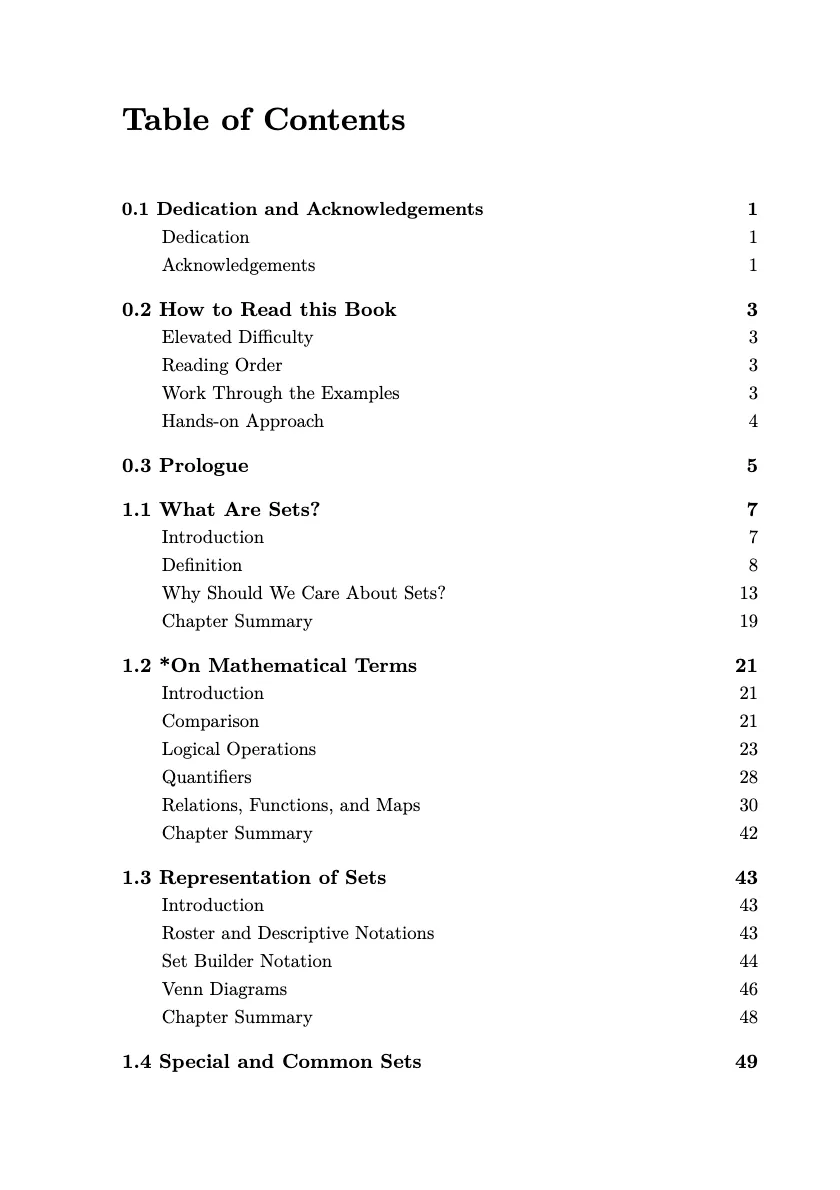
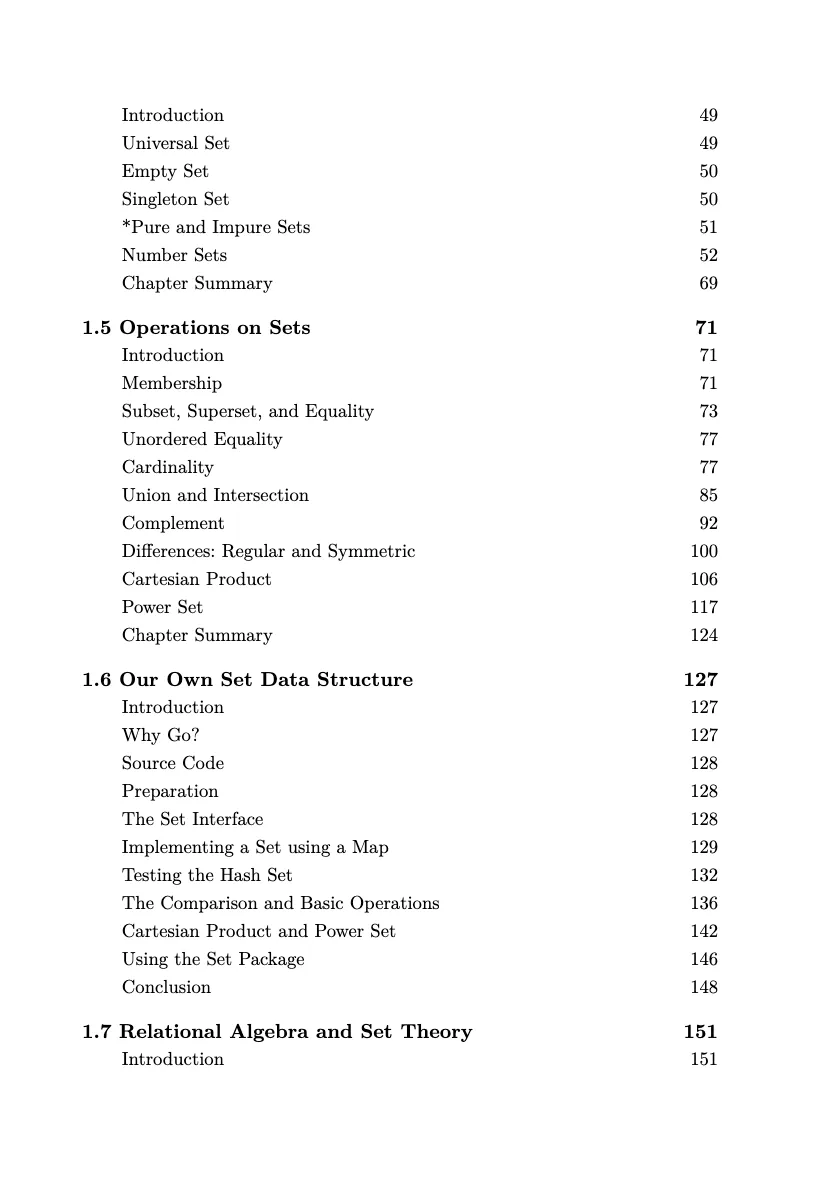
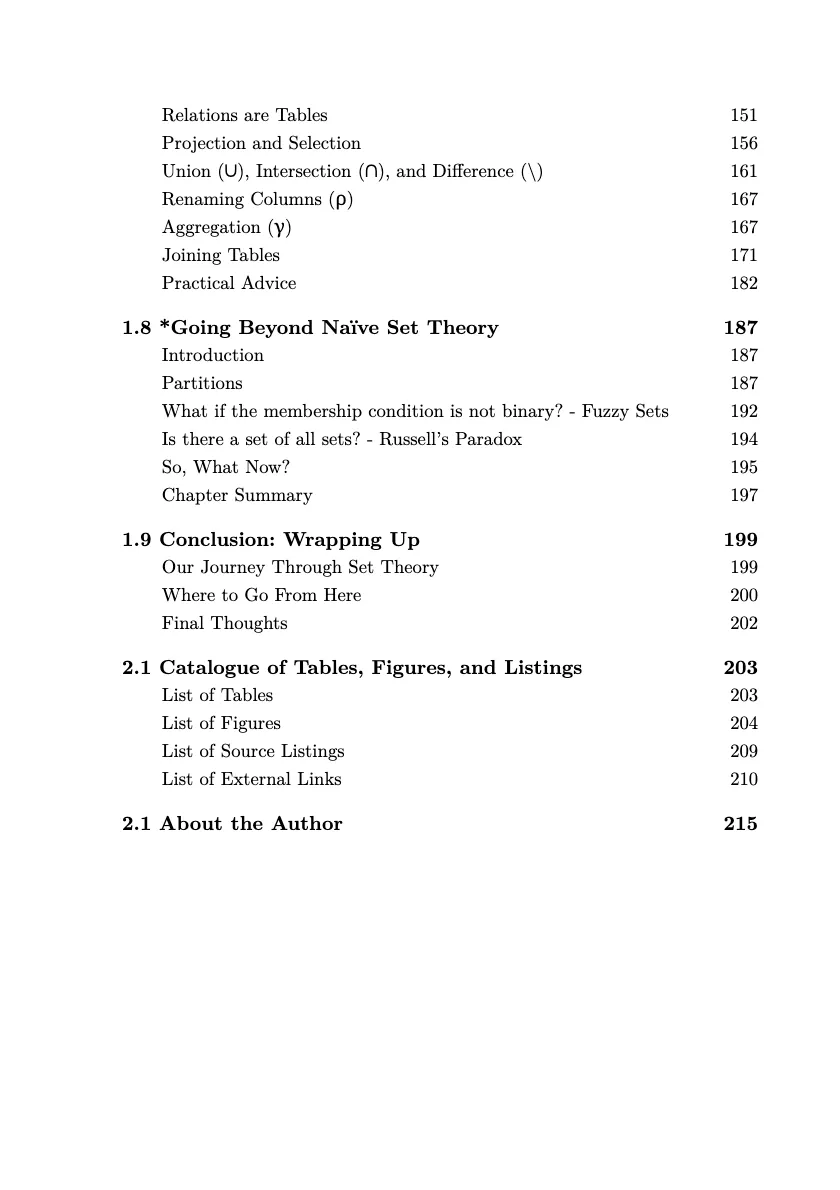
* = elevated difficulty