Representation of Sets: Set Builder Notation and Venn Diagrams

To new concepts correspond, necessarily, new signs. These we choose in such a way that they remind us of the phenomena which were the occasion for the formation of the new concepts.
By relieving the brain of all unnecessary work, a good notation sets it free to concentrate on more advanced problems, and in effect increases... mental power... Probably nothing in the modern world would have more astonished a Greek mathematician than to learn that, under the influence of compulsory education, the whole population of Western Europe, from the highest to the lowest, could perform the operation of division for the largest numbers. This fact would have seemed to him a sheer impossibility.
Introduction
We know what sets are and how they can be useful. In this chapter, we will discuss the various ways we can represent sets. We will start with the most basic form of representation and move on to more complex forms. We will also discuss the importance of each form and when to use them.
Roster and Descriptive Notations
We can list all the items in a set to define it. We call it the roster form. A few sets in this form with their descriptions are:
$$A = \{1, 2, 3, 4, 5\}$$
A set of the first five natural numbers starting from 1.
$$B = \{\text{tree}, \text{pebble}, \text{shrub}, \text{flower}\}$$
A set of things you would spot in nature.
$$C = \{♣, ♦, ♥, ♠\}$$
Set of playing card suits.
$$D = \{1, 2, 3, 4, 5, 6, \ldots\}$$
An infinite set of all the natural numbers starting from 1. Note that theoretically, sets can be infinite. We never need to list all the members of an infinite set. We just need to know a few of them, enough to notice the trend indicated. In almost all situations that need infinite sets, we need the idea that binds the elements together, not the actual elements themselves. There are more examples of infinite sets in the Cardinality section of the full book.
Set Builder Notation
The roster form becomes impractical when we want to convey a non-trivial relationship between the members and simply listing some members might not be enough. An obvious solution here would be to use the description we want to define the set. If we use words, we call it a descriptive definition of the set. If we use a Boolean predicate defined using mathematical notation and symbols, we call it the set builder notation.
We’ve discussed predicates in a previous chapter. They are mathematical expressions that evaluate to either true or false. By applying these predicates to potential members of a set, we can determine if they belong or not. We call these predicates membership conditions.
Previously, we have seen descriptive definitions next to the roster forms. Here are some more next to examples of set builder notation using predicates:
$$E = \{x \mid x \text{ is even}\}$$
This is a set of all elements that are even. We assume that all elements in this context are numbers. Note the syntax being used. The element belonging to the set is identified by the variable x. We allow x to be a member of the set only if the condition “x is even” is satisfied.
$$F = \{a \mid a \text{ is prime} \land a < 10\}$$
Set of all integers which are prime, and they are less than 10. See how we can be very specific in our description by connecting smaller logical expressions or predicates into larger ones?
$$G = \{z \mid 1 < z \leq 3\}$$
Set of all real numbers - which can be represented on the number line - between 1 (excluding it) and 3 (including it). In disciplines such as calculus and algebra, we use these types of sets often. To make it convenient, we use a shorthand interval notation.
This set would be represented in interval notation as (1, 3]. The parenthesis indicates that the set is “open” on the left-hand side (with the smaller number) and the square bracket represents the set is “closed” on the right-hand side (with the larger number). When one side of the interval is open, the number is excluded. The endpoint number is included if the interval is closed. Another property we could assign this set is being “half-open”. Can you figure out what being (fully) open and (fully) closed means in terms of intervals?
You might find other textual ways to represent sets, but in essence, they will be derived from one of these three basic methods discussed above.
Venn Diagrams
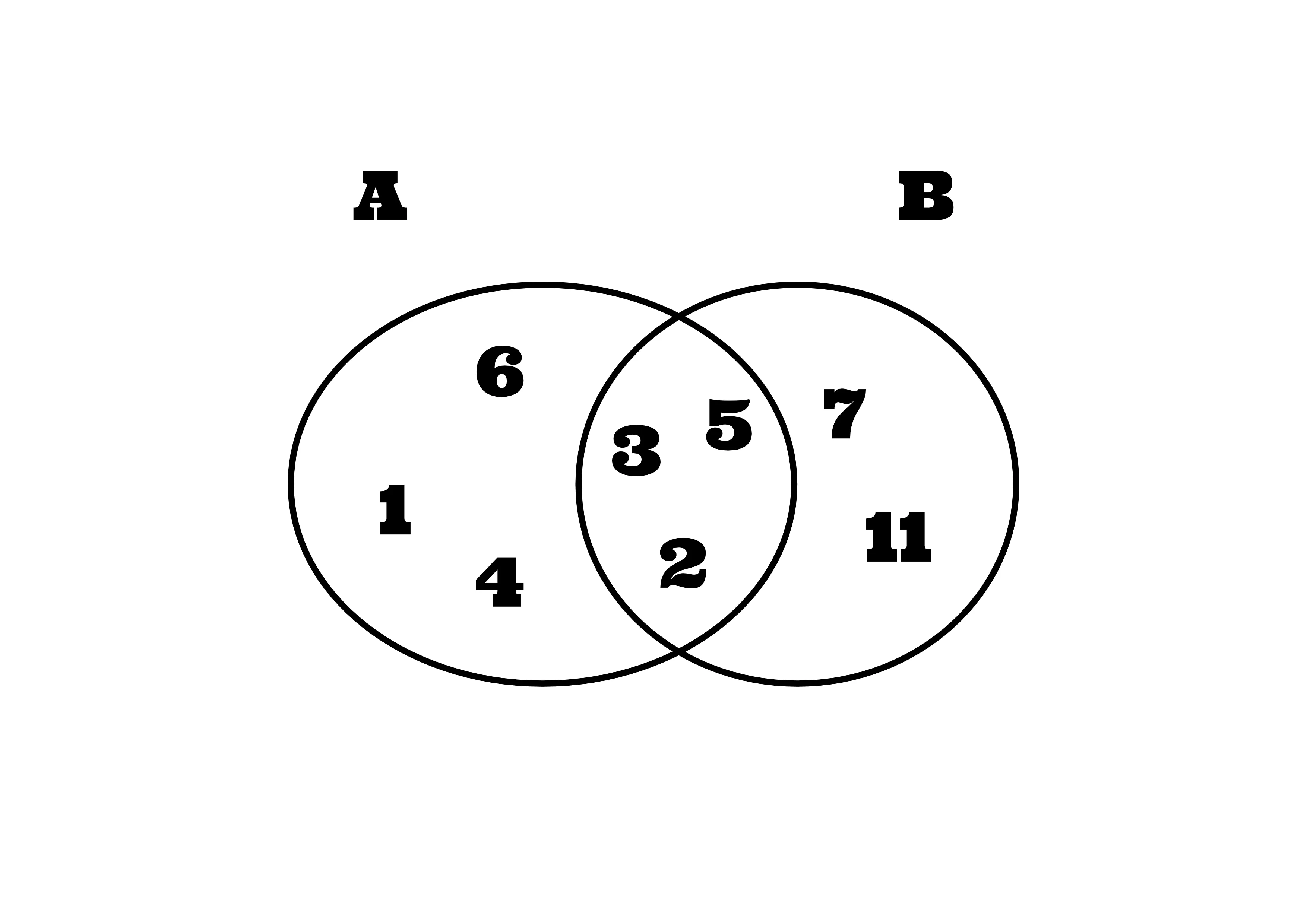
You might not always want to extract information about sets from staring at a wall of text or a cryptic mathematical expression. If you have two or more sets, the relationship between them might not be immediately obvious. Let us take the following sets A and B:
$$A = \{1, 2, 3, 4, 5, 6\}$$
and
$$B = \{2, 3, 5, 7, 11\}$$
What elements do they have in common? 2 is common because it belongs to both A and B. So is 3. But what about the others? It is not clear from an immediate inspection. The readers need to do some additional work to convert B to its roster form, then identify the common elements.
Now consider the representation of the same sets using a Venn diagram:
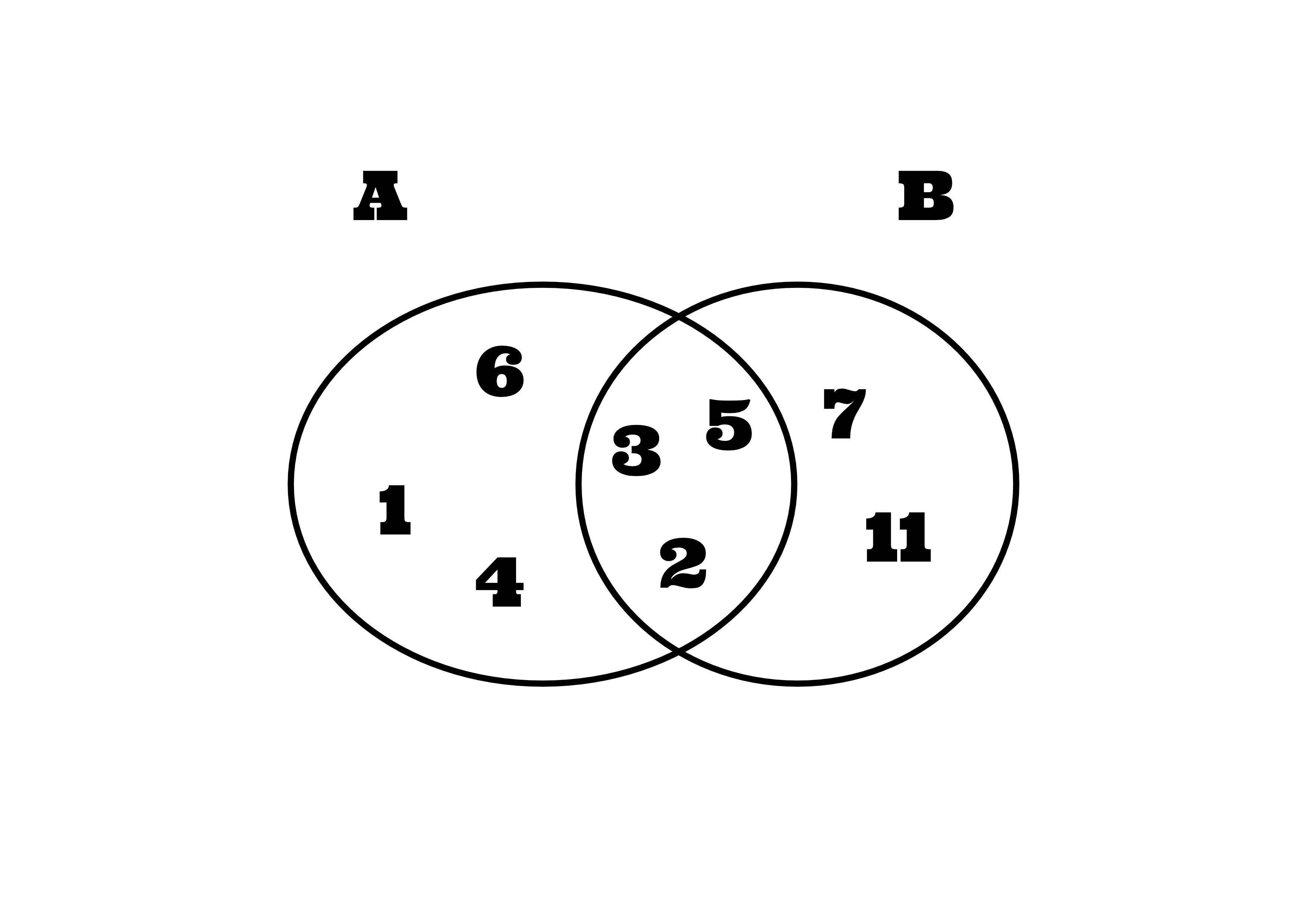
The ellipse with A next to it represents the bounds of the set A. Set B has a similar representation. The region where they overlap shows the elements they have in common. We will see later that this region is known as the intersection of sets A and B.
Chapter Summary
Sets are important in mathematics and related fields. They are the simplest potential building blocks of more complex structures. However, they can be a bit too abstract and unintuitive if we do not have any relatable examples. To explain the examples and show the various properties we wish to highlight, we need different ways to represent sets.
In this chapter, we looked at the simplest ways first: roster form - where we list all the elements of a set, and descriptive notation - where we describe the set using words. We then moved on to set builder notation, where we use a logical membership condition to define the set. Finally, we discussed Venn diagrams, which are graphical representations of two or more sets and their relationships.
This is the end of Chapter 1.3. The book continues with chapters on special sets, operations on sets, and much more. Get the full book to continue your set theory journey.
Comments