Articles tagged: TODIM
TODIM (an acronym for TOmada de Decisão Interativa e Multicritério, Portuguese for interactive and multi-criteria decision making) is an MCDM method that ranks alternatives by computing pair-wise dominance degrees across all criteria. Whereas TOPSIS and similar distance-based methods gauge proximity to an ideal outcome, TODIM determines the extent to which each alternative dominates all others, on a criterion-by-criterion basis. Its distinguishing feature is a built-in treatment of loss aversion: gains and losses relative to a reference alternative are not weighted symmetrically. This gives the method a behavioural grounding that purely algebraic approaches lack.
The method was introduced by Gomes & Lima (1992a, Foundations of Computing and Decision Sciences 16(4), 113–127), drawing explicitly on Kahneman & Tversky’s (1979) prospect theory. Prospect theory overturned the classical assumption that decision-makers optimise expected utility; it showed instead that people evaluate outcomes relative to a reference point, and that losses loom larger than equivalent gains. Gomes and Lima formalised this asymmetry within an MCDM framework, giving TODIM a philosophical grounding that separates it from utility-theory-based methods. The decision-maker need not be modelled as a rational actor seeking to maximise a single coherent utility function.
The core of the method rests on a dominance degree function. For each pair of alternatives $A_i$ and $A_j$ and each criterion $c$, a partial dominance value $\Phi_c(A_i, A_j)$ is computed. It is positive when $A_i$ outperforms $A_j$ on that criterion, and attenuated by a factor $\theta$ when it underperforms. This attenuation factor (typically estimated from the data or set by the analyst) captures the degree of loss aversion: a larger $\theta$ means losses are felt less acutely relative to gains. Summing these partial dominance values across all criteria yields a global dominance degree $\delta(A_i, A_j)$, and the overall score of each alternative is derived by aggregating its dominance over all competitors. A detailed exposition of the algorithm, including worked examples, is available in Gomes & Rangel (2009).
To manage decision contexts with ambiguous or language-based information, several variants have been developed. Fuzzy TODIM replaces crisp criterion weights and performance values with fuzzy sets (Zadeh (1965)) or linguistic variables (Zadeh (1975)), accommodating the vagueness inherent in expert judgement. A more fundamental extension, CPT-TODIM, reworks the dominance function using cumulative prospect theory as developed by Tversky & Kahneman (1992), adding a probability-weighting step that adjusts for the observed human tendency to overweight small probabilities and underweight large ones. Gomes, Machado & Rangel (2013) explore further generalisations using Choquet integrals. Llamazares (2018) provides a rigorous mathematical analysis of the general TODIM model, clarifying the conditions under which the method produces consistent rankings.
TODIM and its variants have found application across a wide range of fields: social sustainability assessment, supplier selection, healthcare resource allocation, energy planning, and infrastructure project ranking. The body of TODIM literature continues to grow as researchers adapt the method to new decision contexts and data types, making it one of the more active areas within behavioural MCDM. Read more about articles on this MCDM algorithm from us on this page.
Articles
Comparing TODIM and CPT-TODIM for Social Sustainability Assessment in G7 Countries


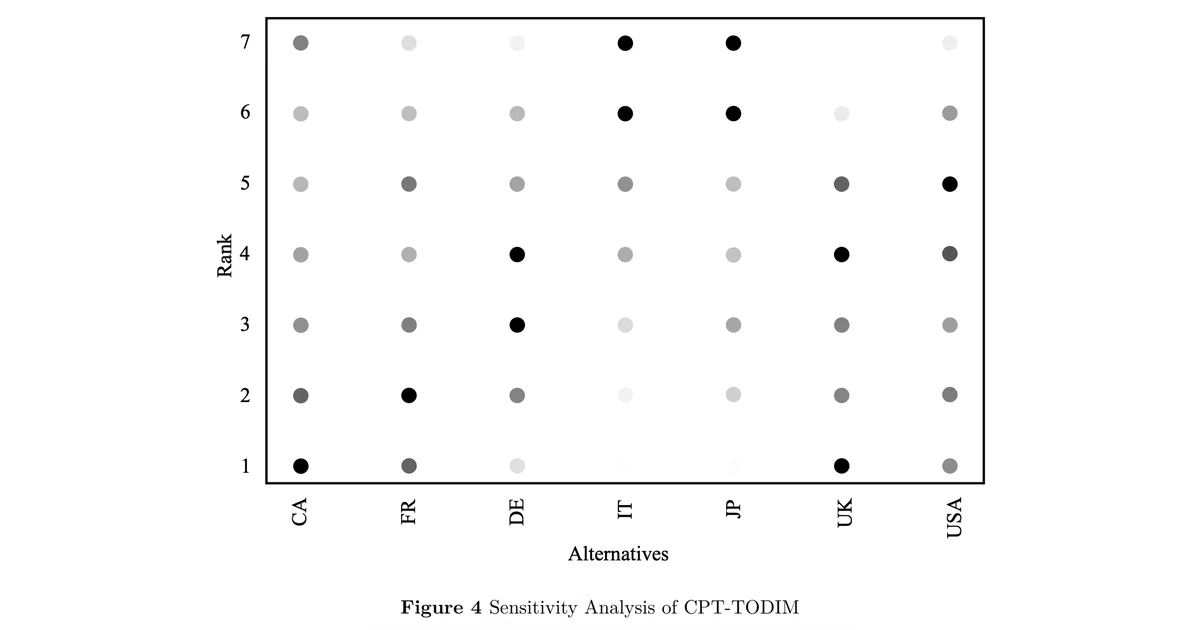
We compare decision-making algorithms to rank G7 countries on social sustainability. CPT-TODIM proves most stable out of TODIM and CoCoSo.